Pricing custom cabinet work is one of the hardest things to get right. Quote too high and the client ghosts you. Quote too low and you're working for free—or worse, losing money. Most cabinet makers learn pricing through painful trial and error, but it doesn't have to be that way.
This guide breaks down a repeatable system for estimating materials, labor, overhead, and profit so you can quote jobs with confidence and stop leaving money on the table.
Start With a Detailed Cut List
Before you can price anything, you need to know exactly what you're building. A vague "ten-foot run of uppers and lowers" isn't enough. You need a complete cut list that accounts for every panel, shelf, face frame, and filler strip.
For each cabinet in the project, list out:
- Case parts — sides, top, bottom, back, stretchers
- Shelves — fixed and adjustable
- Face frames — stiles, rails, and any mullions
- Doors and drawer fronts — including style (slab, shaker, raised panel)
- Drawer boxes — sides, front, back, and bottom
A thorough cut list is the foundation of an accurate estimate. Skip this step and everything downstream is a guess.
Estimating Material Costs
Sheet Goods
Sheet goods are typically your largest material expense. To estimate cost:
- Total up your cut list by material type and thickness (e.g., 3/4" pre-finished maple, 1/2" Baltic birch for drawer boxes, 1/4" plywood for backs).
- Calculate the number of sheets you'll need. A standard 4×8 sheet gives you 32 square feet, but real yield is closer to 85–90% after accounting for saw kerfs, grain matching, and defects.
- Multiply by your per-sheet cost, including tax and delivery if applicable.
A rough rule of thumb: for a typical 10-foot kitchen with uppers and lowers, plan on 8–12 sheets of 3/4" plywood and 2–3 sheets of 1/4" for backs.
Hardware
Hardware adds up fast. Make a checklist for each cabinet:
- Hinges — soft-close concealed hinges run $2–5 each; budget 2 per door
- Drawer slides — soft-close full-extension slides range from $8–25 per pair depending on length and brand
- Shelf pins — pennies each, but don't forget them
- Knobs and pulls — varies wildly; get the client to choose before quoting, or spec a standard and price upgrades separately
- Hanging hardware — rail systems, screws, shims
Edgebanding and Finishing Materials
- Iron-on edgebanding — approximately $0.30–0.50 per linear foot for PVC or melamine
- Solid wood edging — more labor-intensive; factor in milling time
- Finishing supplies — stain, lacquer, topcoat, sandpaper, and spray materials if you're finishing in-house
Countertops and Specialty Items
If you're supplying countertops, get a quote from your fabricator and add 10–15% for coordination. Same goes for glass inserts, specialty moldings, or custom turnings.
Calculating Labor Hours
Labor is where most shops underestimate. Be honest about how long things actually take you—not how long you think they should take.
Break the Job Into Phases
| Phase | Typical Hours (10-ft kitchen) |
|---|---|
| Cut list & planning | 2–4 hrs |
| Sheet breakdown & milling | 4–6 hrs |
| Case assembly | 8–12 hrs |
| Face frames | 3–5 hrs |
| Doors & drawer fronts | 6–10 hrs |
| Drawer boxes | 3–5 hrs |
| Finishing / spraying | 6–10 hrs |
| Hardware installation | 2–4 hrs |
| Delivery & site install | 4–8 hrs |
| Total | 38–64 hrs |
Your numbers will vary based on shop efficiency, equipment, and cabinet complexity. Track your actual hours on a few jobs and you'll have much better data for future quotes.
Setting Your Shop Rate
Your shop rate needs to cover your wages plus overhead. A common formula:
Shop rate = (Desired salary + overhead) ÷ billable hours per year
If you want to earn $75,000/year and your overhead (rent, utilities, insurance, equipment payments, consumables) is $35,000/year, and you can realistically bill 1,600 hours:
($75,000 + $35,000) ÷ 1,600 = $68.75/hr
Round to $70/hr for simplicity. Many one-person shops charge $55–85/hr; larger shops with employees may charge $85–120/hr or more.
Adding Overhead and Markup
Overhead Recovery
Some shops bake overhead into their hourly rate (as above). Others apply a percentage on top of material costs—typically 10–20%—to cover waste, consumables, and shop supplies that don't get itemized per job.
Profit Margin
After covering all costs and your salary, you still need profit. Profit is what funds equipment upgrades, handles slow months, and grows your business.
A healthy profit margin for custom cabinet work is 10–20% on top of total costs. Some shops use a markup multiplier instead:
- 1.5× materials = 50% markup
- 1.15× total job cost = 15% profit margin
Pick a method and be consistent.
Presenting the Quote to Your Client
How you present the number matters almost as much as the number itself.
- Itemize by area or cabinet group, not by individual line items. Clients don't need to see that you're charging $4.50 for shelf pins—they want to know the island costs $3,200.
- Include a clear scope of work — what's included, what's not (countertops, appliances, plumbing, electrical).
- Offer options — a "good, better, best" approach lets the client self-select their budget. Maybe the base option uses melamine interiors while the upgrade uses pre-finished plywood.
- State your payment terms — 50% deposit, progress payments, and final payment on completion is standard.
- Set a quote expiration — material prices change. 30 days is reasonable.
Tracking Actual Costs vs. Estimates
The only way to get better at pricing is to track what you actually spend and compare it to your estimate after every job. This is where most shops fall short—they move on to the next project and never look back.
For each job, record:
- Actual material purchases and receipts
- Actual hours worked per phase
- Any change orders or unexpected costs
- Final profit margin
After a few jobs, patterns emerge. Maybe you consistently underestimate finishing time, or your hardware estimates are always 15% low. That data is gold.
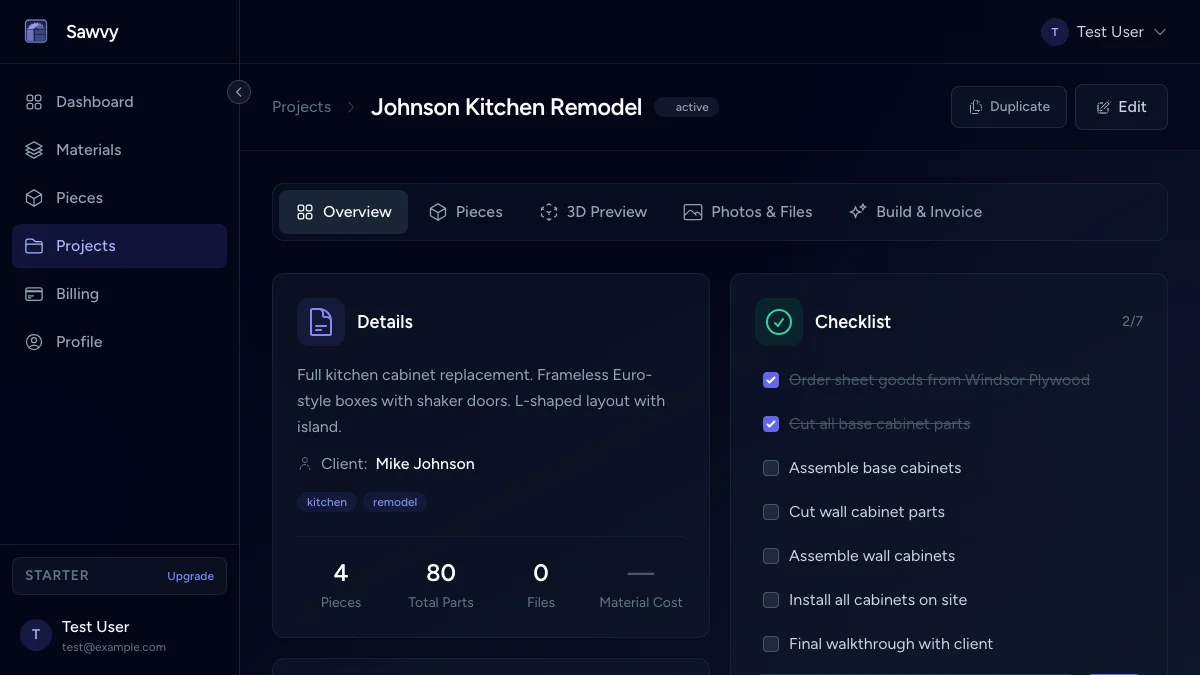
Tracking With Sawvy
If spreadsheet tracking isn't your thing, Sawvy's cost tracking feature lets you log material costs and labor hours directly inside your project. It compares your estimates against actuals as you go, so after a few jobs you'll have solid data on where your margins really land.
Quick Pricing Checklist
Before you send that next quote, make sure you've accounted for:
- Complete cut list with all parts
- Sheet goods (with realistic yield, not theoretical)
- Hardware for every door, drawer, and shelf
- Edgebanding and finishing materials
- Labor hours broken down by phase
- Shop rate that covers wages + overhead
- Delivery, site prep, and installation time
- Profit margin (not just cost recovery)
- Payment terms and quote expiration date
Pricing gets easier the more you do it—especially when you're tracking real data instead of guessing. Build the habit now and your future self will thank you.
Sawvy helps you plan projects, optimize cut lists, and keep tabs on costs — all in one place. Sign up free and see how it fits your workflow.