If you've ever walked into a hardwood dealer and seen prices listed "per board foot," you know the moment of hesitation: How much lumber do I actually need, and what's this going to cost me? Board feet are the standard unit for buying and selling hardwood lumber in North America, and understanding the math behind them is one of the most practical skills a woodworker can pick up.
This guide breaks down the formula, walks through real-world examples, and gives you a quick-reference table so you can estimate costs before you ever leave the shop.
What Is a Board Foot?
A board foot (BF) is a unit of volume. One board foot equals a piece of wood that is 1 inch thick, 12 inches wide, and 12 inches long — or 144 cubic inches of lumber.
It doesn't matter what shape the board is. A 2-inch-thick board that's 6 inches wide and 12 inches long is also exactly 1 board foot. The volume is the same.
The Board Foot Formula
Here's the formula you need:
Board Feet = Thickness (in.) × Width (in.) × Length (in.) / 144
If your length is in feet instead of inches, use this shortcut:
Board Feet = Thickness (in.) × Width (in.) × Length (ft.) / 12
Both formulas produce the same result. Use whichever matches the measurements you have in hand.
Understanding Lumber Thickness: The Quarter System
Hardwood lumber is sold using the "quarter" system, where thickness is expressed in quarters of an inch:
- 4/4 (four-quarter) = 1 inch rough
- 5/4 (five-quarter) = 1.25 inches rough
- 6/4 (six-quarter) = 1.5 inches rough
- 8/4 (eight-quarter) = 2 inches rough
- 12/4 (twelve-quarter) = 3 inches rough
Keep in mind that these are rough-sawn dimensions. After surfacing and planing, a 4/4 board typically ends up around 13/16 inch thick. When calculating board feet for purchasing, always use the rough dimension — that's what you're paying for.
Worked Examples
Example 1: A Simple 4/4 Board
You need a board that's 1 inch thick, 8 inches wide, and 6 feet long.
BF = 1 × 8 × 6 / 12 = 4 board feet
Example 2: Thick Stock for Table Legs
You're buying 8/4 walnut that's 6 inches wide and 4 feet long.
BF = 2 × 6 × 4 / 12 = 4 board feet
Example 3: A Wide Slab
A 6/4 cherry board measures 10 inches wide and 8 feet long.
BF = 1.5 × 10 × 8 / 12 = 10 board feet
Quick-Reference Table: Common Dimensions
This table shows the board footage for common lumber sizes at various lengths. Use it to estimate before you head to the lumber yard.
| Thickness | Width | 4 ft | 6 ft | 8 ft | 10 ft |
|---|---|---|---|---|---|
| 4/4 (1") | 4" | 1.33 | 2.00 | 2.67 | 3.33 |
| 4/4 (1") | 6" | 2.00 | 3.00 | 4.00 | 5.00 |
| 4/4 (1") | 8" | 2.67 | 4.00 | 5.33 | 6.67 |
| 4/4 (1") | 10" | 3.33 | 5.00 | 6.67 | 8.33 |
| 6/4 (1.5") | 6" | 3.00 | 4.50 | 6.00 | 7.50 |
| 6/4 (1.5") | 8" | 4.00 | 6.00 | 8.00 | 10.00 |
| 8/4 (2") | 6" | 4.00 | 6.00 | 8.00 | 10.00 |
| 8/4 (2") | 8" | 5.33 | 8.00 | 10.67 | 13.33 |
How to Use Board Feet for Pricing
Hardwood dealers price lumber per board foot. If walnut is $12/BF and you need 30 board feet for a project, your rough lumber cost is $360 before tax.
Here's a practical approach to estimating project costs:
- List every part in your project with its finished dimensions.
- Add waste allowance. A 20–30% overage is standard for rough lumber. You'll lose material to surfacing, crosscutting defects, and saw kerfs.
- Calculate total board feet for each species and thickness you need.
- Multiply by the per-BF price from your supplier.
A Real-World Estimate
Say you're building a small side table from hard maple at $7.50/BF:
| Part | Qty | T (rough) | W | L | BF Each | BF Total |
|---|---|---|---|---|---|---|
| Top | 1 | 4/4 | 18" | 24" | 3.00 | 3.00 |
| Legs | 4 | 8/4 | 2.5" | 26" | 0.72 | 2.89 |
| Aprons | 4 | 4/4 | 4" | 16" | 0.44 | 1.78 |
| Subtotal | 7.67 | |||||
| + 25% waste | 1.92 | |||||
| Total needed | 9.59 |
At $7.50/BF, that's roughly $72 in lumber — useful to know before you commit to a species.
Tips for Accurate Board Foot Estimates
- Measure rough stock before surfacing. Your dealer measures it rough; you should too.
- Round up, not down. Lumber rarely comes in the exact length you need. You'll buy a 6-foot board even if you only need 5 feet 4 inches.
- Ask about minimums. Some dealers charge for a minimum board foot count per species and thickness.
- Factor in defects. Lower-grade lumber is cheaper per BF but yields less usable wood after cutting around knots and sapwood.
A Faster Way to Estimate
Calculating board feet by hand is straightforward, but it gets tedious when you're planning a project with dozens of parts across multiple species and thicknesses.
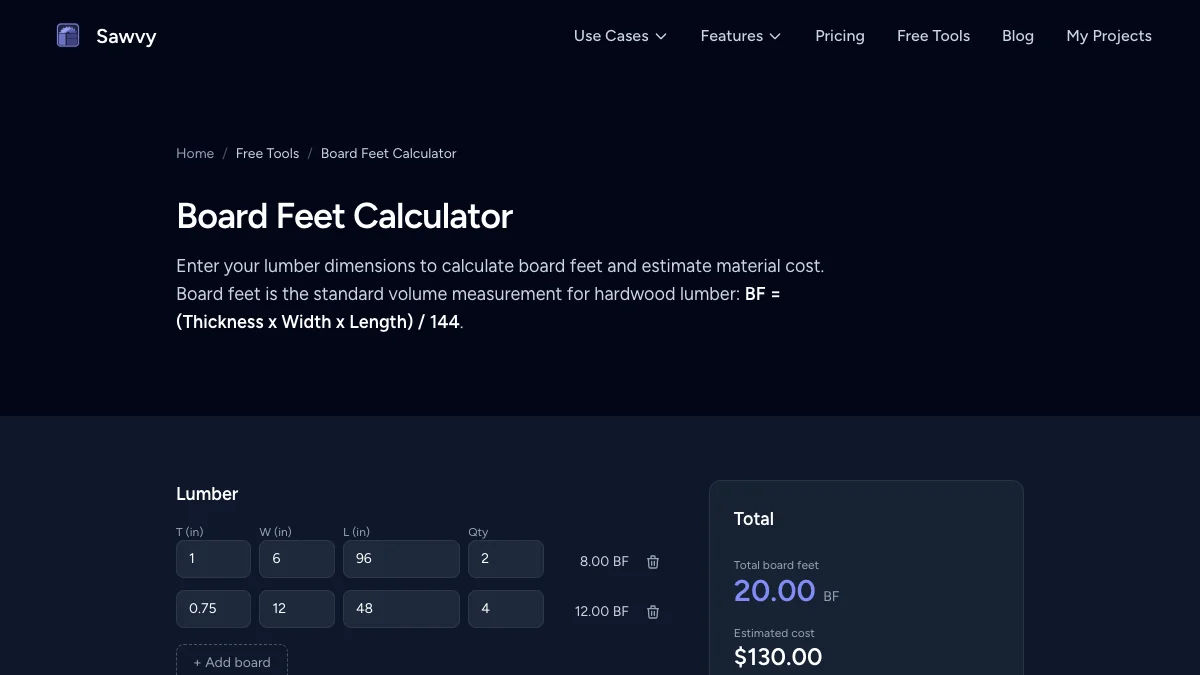
If you'd rather not do the arithmetic by hand, Sawvy has a free board feet calculator that handles the quarter system, waste allowances, and multi-species projects. Punch in your dimensions, set a price per board foot, and it totals everything up for you.
Sawvy is a free project-planning tool for woodworkers. Check it out at getsawvy.com.