Whether you're building kitchen cabinets, a built-in bookcase, or shop furniture, plywood is probably involved. But walk into a lumber yard and you'll find a wall of options—different sizes, thicknesses, species, and grades. Knowing what's available (and what to actually use) saves time, money, and trips back to the supplier.
This guide covers the standard plywood sheet sizes and thicknesses available in the US, breaks down the most common types, and helps you pick the right one for your project.
Standard Plywood Sheet Sizes
The Common Sizes
Most plywood in the US is sold in one of these sheet dimensions:
| Size | Dimensions | Common Uses |
|---|---|---|
| 4×8 | 48" × 96" | The standard. Cabinets, furniture, sheathing—everything. |
| 4×4 | 48" × 48" | Half sheets. Handy for smaller projects or when a full sheet won't fit in your vehicle. |
| 5×5 | 60" × 60" | Baltic birch standard size. Common for drawer boxes, jigs, and shop projects. |
| 4×10 | 48" × 120" | Available in some sheathing grades and specialty panels. Useful for tall applications without seams. |
| 2×4 | 24" × 48" | Project panels sold at big-box stores. Convenient but more expensive per square foot. |
| 2×2 | 24" × 24" | Craft and small project panels. |
The 4×8 sheet is by far the most common and the most economical per square foot. If you're ordering from a lumber yard, this is what you'll get unless you specify otherwise.
A Note on Actual vs. Nominal Dimensions
A "4×8" sheet is nominally 48" × 96", and domestic plywood usually hits those numbers exactly. Baltic birch, however, comes in 5×5 sheets that measure 60" × 60"—not 48" × 96". This matters when you're planning cuts. Some suppliers carry Baltic birch in 4×8 sheets, but expect to pay a premium.
Standard Plywood Thicknesses
Plywood thickness is where things get a little confusing, because the nominal thickness and the actual thickness aren't always the same.
Common Thicknesses
| Nominal | Actual (Domestic) | Actual (Import/Baltic Birch) | Typical Uses |
|---|---|---|---|
| 1/4" | 7/32" – 1/4" | 6mm (~15/64") | Cabinet backs, drawer bottoms, panel inserts |
| 3/8" | 11/32" | 9mm (~23/64") | Drawer bottoms (heavy-duty), small shelves |
| 1/2" | 15/32" | 12mm (~15/32") | Drawer boxes, cabinet backs (heavy), shelving |
| 5/8" | 19/32" | 15mm (~19/32") | Shelving, subfloors, specialty applications |
| 3/4" | 23/32" | 18mm (~45/64") | Cabinet cases, face frames, doors, furniture |
| 1" | — | 24mm (~15/16") | Workbenches, heavy shelving, jigs |
Why This Matters
If you're cutting dados or rabbets to accept plywood panels, you need the actual thickness—not the nominal. A 3/4" dado will be sloppy with domestic 23/32" plywood, and even worse with 18mm Baltic birch. Many woodworkers keep undersized router bits or dado shims on hand specifically for this reason.
When planning joinery, always measure your actual stock with calipers before cutting joints.
Types of Plywood
Not all plywood is created equal. Here's a breakdown of the types you'll encounter most often.
Cabinet-Grade Hardwood Plywood
This is the workhorse for fine woodworking and cabinetry. It features a hardwood veneer face (maple, birch, oak, walnut, cherry) over a softwood or hardwood core.
- Face grades: A (best) through D. Most cabinet work uses A1 or A2 (good one side or good both sides).
- Core types: Veneer core (strongest, lightest), MDF core (flattest, heaviest), and combination core.
- Best for: Cabinet cases, shelving, furniture, anything that will be seen.
Tip: MDF-core plywood is dead flat and holds screws well at the face, but it's heavy and doesn't hold screws well at the edge. Veneer core is lighter and stronger but can have internal voids. Choose based on your application.
Baltic Birch Plywood
The gold standard for drawer boxes, jigs, and anything with exposed edges. Baltic birch has more plies (typically 9–13 in 3/4"), no internal voids, and birch throughout the entire panel.
- Sold in: 5×5 sheets (standard) or 4×8 (specialty)
- Thicknesses: 3mm up to 24mm
- Edge quality: Clean, attractive layers that can be left exposed with just a clear finish
- Best for: Drawer boxes, shop jigs, CNC projects, anything with visible edges
CDX / Sheathing Plywood
Construction-grade plywood with a rough face. The "C" and "D" refer to face and back veneer grades; the "X" means the glue is rated for exposure (not permanent exterior use).
- Thicknesses: 3/8", 1/2", 5/8", 3/4"
- Best for: Subfloors, roof sheathing, shop utility shelving, and other structural applications where appearance doesn't matter
MDF (Medium-Density Fiberboard)
Technically not plywood, but sold in the same sheet sizes and often stocked alongside it. MDF is made from wood fibers bonded with resin under heat and pressure.
- Pros: Perfectly flat, no grain direction, paints beautifully, inexpensive
- Cons: Heavy, swells when wet, doesn't hold screws well (especially at edges), creates fine dust when cut
- Best for: Painted cabinet doors, templates, router table tops, molding profiles
Melamine / Thermally Fused Laminate (TFL)
A particleboard or MDF core with a melamine paper surface fused to both faces. Available in white, almond, gray, and wood-grain patterns.
- Pros: Pre-finished (no painting or staining), durable surface, inexpensive
- Cons: Chips easily when cut (use a scoring blade or blue tape), heavy, edges need banding
- Best for: Cabinet interiors, closet systems, garage storage, shelving
Choosing the Right Plywood for Your Project
Here's a quick decision framework:
- Cabinet cases (visible) → Cabinet-grade hardwood plywood, veneer core
- Cabinet cases (painted) → MDF-core hardwood plywood or paint-grade birch
- Cabinet interiors → Melamine or pre-finished plywood
- Drawer boxes → 1/2" Baltic birch
- Cabinet backs → 1/4" hardwood plywood or 1/4" Baltic birch
- Shelving (heavy loads) → 3/4" veneer-core or Baltic birch
- Shop jigs & fixtures → Baltic birch or MDF
- Painted doors → MDF (solid or MDF-core plywood)
Planning Your Sheet Usage
Once you know what type and thickness you need, the next question is: how many sheets?
Manually fitting parts onto sheets is tedious and error-prone. You'll inevitably over-order (wasting money) or under-order (wasting a trip). Even a quick sketch on graph paper helps, but for anything beyond a simple project, a cut list optimizer pays for itself on the first job.
Check Your Waste Before You Buy
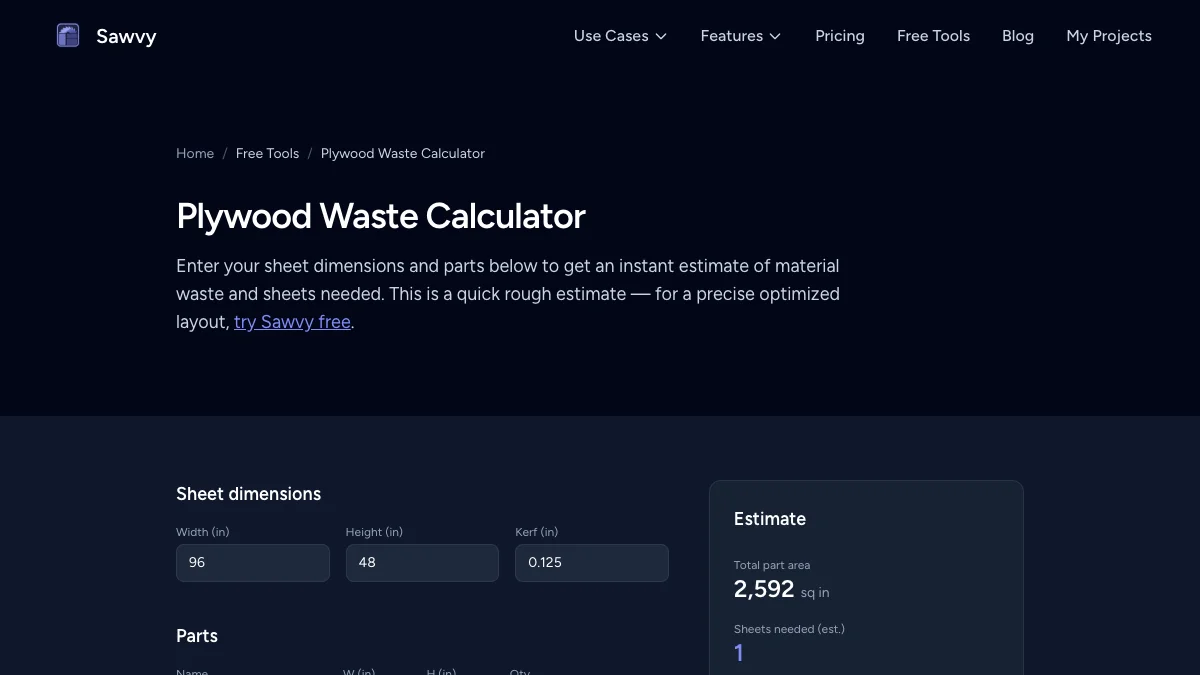
If you want a quick sanity check before loading up the truck, Sawvy's free plywood waste calculator lets you plug in your cut list and see how many sheets you actually need — along with waste percentage and a visual layout showing where each part lands on the sheet. It accounts for blade kerf, grain direction, and different sheet sizes. No account required.
Quick Reference: Sheet Coverage
For quick mental math when estimating:
| Sheet Size | Square Feet | Usable (≈85% yield) |
|---|---|---|
| 4×8 (32 sq ft) | 32 | ~27 sq ft |
| 5×5 (25 sq ft) | 25 | ~21 sq ft |
| 4×4 (16 sq ft) | 16 | ~14 sq ft |
| 4×10 (40 sq ft) | 40 | ~34 sq ft |
The 85% yield figure accounts for saw kerfs, trim cuts, and typical waste. Complex projects with many small parts may yield higher; projects with large panels and grain matching may yield lower.
Wrapping Up
Plywood selection comes down to matching the material to the job. Use the best grade where it matters (faces, drawer boxes, visible edges) and save money with utility grades where it doesn't (backs, substrates, shop projects). Measure actual thickness before cutting joinery, and always plan your cuts before buying sheets.
Sawvy helps you plan projects and get the most out of every sheet. Give it a try — it's free to start.